Why Women Start Losing Bone Earlier Than They Think
July 21, 2026
Bone loss doesn't begin in your senior years. In fact, it often starts decades earlier. In this episode of Dishing Up Nutrition, dietitians Melanie Beasley and Britni Vincent explain why women should start thinking about bone health long before menopause and how simple nutrition and lifestyle habits can make a lasting difference. They discuss the role of protein, calcium, vitamin D, vitamin K2, magnesium, strength training, hormones, and more, while also debunking common myths about osteoporosis.
Listen below, or subscribe to our podcasts through Apple Podcast or Spotify.
Join our Dishing Up Nutrition Facebook Community!
A private, supportive space to ask questions, share ideas, and get bonus content from our nutrition team.
Similar Podcast Episodes
Similar Articles
Transcript
Melanie: Welcome to Dishing Up Nutrition, brought to you by Nutritional Weight & Wellness. Today's topic is one every woman needs to hear, no matter what the age. And we're talking about why women should be thinking about their bone health early on, not just in their senior years, and why they may be losing bone earlier than they think they might be. We think of it as an old woman's disease.
Britni: And it's not.
Melanie: And it’s not. There are a lot of men that have it, but it's not on their radar. And when you hear the word osteoporosis, you might picture a woman with a hunchback or someone who broke a hip after a fall, but you know bone decline doesn't begin at an older age.
In fact, the process that eventually leads to osteoporosis often starts decades earlier and long before any symptoms appear. By the time you have symptoms, you're in trouble because it's a silent disease. And that's why today's conversation is so important.
Osteoporosis is often called the silent disease because you just don't feel your bones getting weaker. People think they might have some bone pain, but that's pretty rare. And you may not have that at all. And you don't notice anything different. Maybe you lose a little bit of height.
But one day someone bends over to lift a laundry basket or they slip on the ice or they trip over the dog. You can even bend over to put something in the oven and suddenly you're dealing with a fracture or a break, which is devastating. And our goal today is to help you understand what happens to bone over a woman's lifetime and more importantly, what you can do now to protect it. I'm Melanie Beasley. I'm a Registered and Licensed Dietitian.
How common is osteoporosis?
Britni: I'm Britni Vincent, also a Registered and Licensed Dietitian. Pleasure to be here with you today, talking about this very important topic. So let's start by just sharing how common osteoporosis really is. According to the Bone Health and Osteoporosis Foundation, about 10 million Americans have osteoporosis. Another 44 million have low bone mass called osteopenia.
Britni: And nearly eighty percent of people with osteoporosis are women. That means millions of women are walking around with weakened bones and many don't even know about it.
Melanie: Right. You know, it used to be you turned fifty and you got a colonoscopy, a mammogram, and a DEXA scan. It was a trifecta. Now it's not until you're sixty-five.
Britni: It’s a long time.
Melanie: Yeah, I think it's criminal. You know, and fractures from osteoporosis aren't just inconvenient. They can be life changing. A hip fracture often requires surgery, lengthy rehabilitation, and can significantly reduce independence. Spinal fractures can lead to chronic pain, loss of height, poor posture, reduced lung capacity.
It sounds so benign. I've had several clients who have had vertebral fractures in their spine and they're in so much pain. When we say chronic pain, I'm talking agony. And even wrist fractures can make everyday activities difficult.
Britni: Of course. One statistic that surprises many people is that half of women over age fifty will experience an osteoporosis related fracture during her lifetime. The good news is osteoporosis is largely preventable when we start paying attention early.
Melanie: Yes. And even if you have osteopenia or osteoporosis, you can reverse that naturally. You'll be told you can't. When I had severe osteoporosis, I was told I could not reverse it naturally. Well, I don't have it anymore and I have not taken a drug. So there's hope.
Why are women at higher risk for osteoporosis than men?
And you may be wondering why are women so much more at risk for osteoporosis than men? And we think of osteoporosis as something only women need to worry about. And while men can definitely still develop osteoporosis, several factors put women at greater risk. And the biggest one is estrogen.
Estrogen does far more than regulate reproductive health, and it also helps maintain healthy bone remodeling. Throughout life, your skeleton is constantly being broken down and rebuilt. It actually takes about 10 years to break a total skeleton down and rebuild it. But estrogen helps keep that balance in check.
Then once estrogen begins declining during perimenopause and menopause, bone breakdown starts happening faster than bone rebuilding. And the result of that is a bone loss accelerates. You know, and if you're a woman who starts with small bones to begin with, you're a small frame, small bones, you don't have as much bone to lose.
Britni: That's an important part of the puzzle, too. And with the hormones, estrogen is a big key player, but progesterone plays a role as well, stimulating bone formation.
Melanie: And testosterone.
Britni: So that loss, again, during perimenopause, menopause, that hormone connection is really big. And you know, you mentioned women having a smaller frame. Women also tend to have lower muscle mass, which can impact bones as well. So there's just less reserve once you start losing.
And there are additional dietary factors specific to women that may increase risk even before menopause. And you know, as dietitians, of course, we always look at everything through the lens of food. So factors like chronic dieting, low calorie intake, eating disorders, excessive exercise without adequate nutrition, thyroid conditions, autoimmune conditions, all of that can play a role in your bone health.
One of the more common reasons people come in is digestive conditions. Well, if you have a lot of digestive symptoms, you're likely not absorbing the nutrients from your food efficiently. So again, that's going to have a big impact on your bones. Common medications can also contribute to poor nutrient absorption. I always think of PPIs, proton pump inhibitors, those acid reflux medications.
Melanie: Like omeprazole. You know, and I think too, women are more likely to go on antidepressants. And antidepressants also prevent that bone remodeling and lead to bone loss. So chronic medication use and like you said, poor digestion. If you have chronic diarrhea, the transit time of your food, it doesn't have enough time to be absorbed. So that's also an absorptive issue. So not only the heartburn, but if you have chronic diarrhea, you just can't absorb it. Women are more likely to have gastric bypass surgery, which limits the absorptive surface of nutrients. And so they're more likely to have osteoporosis.
At what age do women start losing bone density?
And you may be wondering, at what age do women start losing bone density? It can be any age. It might be poor nutrition when you were a toddler. And what age should we really start paying attention? Well, this is where many people are surprised. Your bones are actually strongest in your late 20s. That's when you're living fine.
And most women reach what's called peak bone mass somewhere between twenty-five and thirty. So think of it like a retirement account. The more bone you build early in life, the more you have available later. So most women will lose some bone over time.
Britni: Then after around the age of 30, most women begin to slowly lose small amounts of bone each year. It's usually gradual, so you're not going to notice it, but the process has already started. And that's why even in your 20s and your 30s, it is not too early to start thinking about your bone health. Because really there's some of the most important years, again, thinking of it as a retirement account.
Melanie: You know, and if you think back to somebody in your family, your grandmother, your mother, and they've had osteoporosis, that also increased the odds that you are at risk. So that being said, the fastest bone loss happens during the menopause transition. Women may lose approximately 10 to 20% of their bone density in the five to seven years after menopause. That's an incredibly rapid change.
Britni: Yeah it is. And some women begin losing bone earlier, especially during that perimenopause time before they've even stopped having periods. Those hormonal fluctuations are going to begin affecting bone remodeling years before menopause officially occurs. So again, I encourage people in their late 30s or 40s entering into that perimenopause phase to really start prioritizing their bone health with nutrition, strength training, adding in some key supplements.
And the good news is that we now know more about prevention of osteoporosis so we can be proactive. And nutrition, strength training, key supplements, that's going to impact your whole body for the better.
Melanie: We have a success story. We did a podcast. We interviewed her on Jennifer. And she was young when she had osteoporosis, very young. And there was absorptive issues from abdominal surgeries and some other factors that played in a role, but she was fracturing in her 30s. So we have to take it seriously.
The science of how bone remodeling works
And I want to explain more of the science of how bone remodeling works because it's fascinating. Your skeleton isn't a static structure, it's not concrete. It's not just a frame. It is a living tissue. It's continually breaking down and building up. And old bone is continuously being removed by cells called osteoclasts.
So when we move and we bend, our bones bend with us. And that creates microfractured bone that needs to be removed. And they're being removed by a little Pac-Man called osteoclasts. And new bone is built by osteoblasts. Those are like little brick layers. And in our youth, bone building exceeds bone breakdown.
And that's how we grow. By adulthood, the process balances out and we stop growing. But later in life, especially for women after menopause, because of this estrogen piece, bone breakdown starts exceeding bone formation. The older we get, the more we start removing more bone than we're laying down, and we get thinner bones.
Britni: Another key thing here to consider is that nutrition influences every step of that bone remodeling process. Your body needs enough protein to build collagen for your bones. We also need minerals to harden bone. We need vitamin D to absorb calcium. We need vitamin K to help direct calcium into the bones.
Magnesium is part of hundreds of enzymatic processes, many of which involve bone metabolism. So bone health truly requires a matrix of nutrients that work together. It is not as simple as calcium.
Melanie: No. And I don't know about you, but whenever I get someone with osteoporosis and I put together the protocol for them, they're a little shell shocked because it is a part-time job. You know, it has to always be on your brain of what you're doing. But risk-benefit analysis, if you don't address it, your body will make you address it at some point. And you don't want to wait till you're unable to exercise because of fractures.
What are possible early signs of osteoporosis?
So you may be wondering, what are the early signs of osteoporosis? How would I know if I'm at risk? Well, that's really the difficult part because most people have no symptoms. That's why osteoporosis is often called the silent disease. And you can only really know your bone status after you get a bone density scan.
So I had no clue. I thought, well, I'm always telling my clients to get a DEXA scan. I should probably get one. And when I got one and they said it was severe, I was stunned. I've always eaten well, I've always exercised. But with cancer, early onset menopause at 40, that estrogen piece really played a role.
So you want to be on top of it. If you're curious and you're not 65 and your insurance doesn't cover it, a chiropractor can write the order and out of pocket, it's under about a hundred bucks. So then you have a baseline so that you know what are my bones doing? What's the trajectory of my bones? Am I losing bone or am I staying the same from when I had a DEXA scan at fifty five?
Britni: And there's even some direct to consumer places where you can just on your own purchase a DEXA scan. So there are options out there so you have a baseline.
Melanie: Don't live in fear, live in knowledge. Some of those signs or clues that you might have osteoporosis are loss of height, a stooped posture, gum recession is a big sign, recurrent fractures, fragility fractures. I'm not talking you fell, you were skiing, you hit a mogul, and you fractured your leg. That's a trauma fracture.
So a fragility fracture would be a very minor fall or lifting something that really is not that heavy for your muscles and you fracture. A weak grip strength is something that they use to measure your risk of osteoporosis. Loss of muscle mass. Muscle and bone are a team. So if you're losing a lot of muscle because of inactivity, perhaps, you are probably losing bone that's attached to that muscle.
But unfortunately, many women don't discover they have osteoporosis until their first fracture. And that's why this screening proactively really matters. We lose more women to osteoporotic fractures as they age than we do breast cancer, ovarian cancer, and uterine cancer combined. It's the unsung disease that no one talks about until it's too late.
Britni: Yeah, there's also some extra risk factors that play a role. Women should especially be proactive if they have a family history of osteoporosis, a parent who fractured a hip, early menopause before the age of 45, surgical menopause or hysterectomy, low body weight, history of smoking, heavy alcohol use, long-term steroid use, long-term use of acid-reducing medication. Rheumatoid arthritis, celiac disease, inflammatory bowel disease, hyperthyroidism, hypothyroidism, vitamin D deficiency.
Melanie: I'm going to throw a few extras in there. Antidepressant use. You know, if you've been on antidepressants for a long time, that can demineralize your bones. Certain medications, if you have lupus, there's a lot of medications that can really decrease it and a family history is a risk. So the general recommendation is that women have a DEXA bone density scan at 65.
However, like we mentioned, get screened earlier if you have these conditions or risks or worries or you just want a baseline to see where did I start and where am I going? If that's the case, you can get one out of pocket. They're not that expensive, but waiting until you're 65 is kind of risky because you could do something about it immediately.
I want to mention before we go to break, August 2nd, we will be starting the 28 Days to Stronger Bones, a real food nutrition challenge. If you are interested in that, go to weightandwellness.com. You can sign up or you can give us a call. But this is a great class. I'm the presenter, so I can say that.
Britni: It’s wonderful.
Melanie: It's a class that is all things bone. And then you also get live Q&As with me. So we'll be right back.
-----
Britni: Welcome back to Dishing Up Nutrition. We have been talking all about bone health. And before break, Melanie, you mentioned this upcoming bone challenge. 28 Days to Stronger Bones: a Real Food Nutrition challenge. Registration opens up on July 20th. Visit our website, weightandwellness.com for more information.
What can women do to avoid osteoporosis? (#1: eat enough protein)
Now let's dive into the food piece. What can women do to avoid osteoporosis? If you already have an osteoporosis diagnosis, osteopenia diagnosis, I mean, this all applies to you. So first, eat enough protein. Protein is part of the building blocks of making bone. And if you're not consuming enough, your body's not going to be able to make adequate bone. So protein, especially animal protein, is going to provide amino acids needed to build collagen, which forms the structural framework of our bones. And we know that many women unintentionally under eat animal protein.
Melanie: We do. The older we get, unfortunately, it seems like women eat less and less protein when they actually need more and more. Go to our website and search protein. We have a lot of podcasts on how to get enough protein, how to sneak it in, what do you actually need, because knowledge is power.
Britni: It really is. So we really want to aim for at least four ounces of quality animal protein at each meal. I mean, this varies. Everybody may have different needs there, but that's a good place to start. So that includes pasture raised eggs, free range chicken, grass fed beef, free range turkey, wild caught fish, organic dairy like cottage cheese or yogurt are great protein sources if you tolerate them.
And we like to encourage a quality protein powder when dietary protein is just falling short. It's something easy to keep on hand; like our Nutrikey grass-fed whey protein. If you tolerate dairy or whey, I would choose that one. If you don't, you could choose our Paleo protein powders. And these are great tools just to fill in the gaps, especially when we as women struggle to get enough protein in our diets.
Melanie: I had a client and she just recently started tracking her protein. I had her weighing her protein and she consistently was getting two and a half to three ounces of protein thinking she was getting four to five ounces. So it was very eye opening. But the benefit of when we started because she was afraid of osteoporosis. Her mother had it, her grandmother had it. And so I told her bonus protein.
So when she started weighing it out, the benefit not just for her bones, but she's not losing muscle mass. And she said, my gosh, I have so much more energy. And you've talked about clients that say the same thing. It revs your metabolism. You feel great. So don't be afraid of that protein. Weigh it out. See where you are. Knowledge is power.
Calcium: another important bone building block
Another component is calcium. And we think of bone and we've been told calcium, calcium, calcium, calcium. Well, calcium is just like a cousin to all the other things that you actually need. But calcium is one of the building blocks, but it does work best with other important nutrients like vitamin D, vitamin K, magnesium, boron.
There's a whole host of them. And supplementing calcium is often necessary for women to meet their ideal needs, especially those that don't tolerate dairy. But we do encourage getting calcium from food as much as possible. And yes, dairy is high in calcium, but don't get discouraged if you're like me and you don't tolerate dairy in foods.
Some of the highest sources of non-dairy calcium are sardines, canned salmon with bones, cooked greens like collard greens, organic tofu, broccoli, mustard greens, bok choy, kale, arugula. There's also a smaller amount in nuts and seeds like chia seeds and almonds and sesame seeds or tahini.
Adults generally need around a thousand milligrams daily, and that's supplement and diet. So increasing to twelve hundred milligrams after the age of fifty because we don't absorb as well is a really good plan. And that's from both food and supplements. We meet that quota. But you've got to get all the other components in.
Vitamin D is critical for bone health
Britni: We briefly touched earlier on the importance of vitamin D, but the reality is without adequate vitamin D, calcium absorption will drop significantly. So to make the most of all the calcium that you're intaking, your calcium supplement, you need to make sure your vitamin D levels are adequate.
And depending on where you live, sun exposure often just is not enough year-round, especially, you know, we're in Minnesota. You're just not going to get enough vitamin D year round. So have your vitamin D checked. Ideally, I recommend getting your levels checked twice a year.
We're looking for about 50 to 80. Conventional medicine may say 20 to 30 is sufficient, but we really want to see it higher than that. Not only for bone health, but for immune system, many, many factors in our body. So typically we will recommend supplementing with 5,000 IU per day, but this really varies from person to person. I recently had a client, he needed to take 20,000 a day to get his level even to 50.
Melanie: Yeah. And I was doing the Key Osteo Plus and I was taking my vitamin D and mine just got over a hundred. And I was like, I guess I need to not take that vitamin D as frequently. So I just paced it. So knowing what your vitamin D level is, because if it drops below 40, you're actively losing bone and you just don't have the energy to exercise, which contributes to bone loss.
So that prevention we circle back to is keeping your vitamin D in that level between 50 and 80 is optimal. And if you're somebody that really struggles to remember to take your supplement and you're running around 50, that's not good because it's easy to drop below that.
Vitamin K2 & magnesium are critical for bone health
And don't forget about vitamin K2 and magnesium. Vitamin K helps activate proteins involved in bone mineralization. We usually recommend taking vitamin D3 plus K2 supplement as a simple way to cover both your vitamin D and your K2 needs.
And magnesium contributes to both structure and supports vitamin D metabolism. Leafy greens, nuts, seeds, and legumes provide magnesium. However, it really is hard to get enough magnesium from just our diet. And most common supplements that we recommend because it's difficult to get enough from food is Magnesium Glycinate.
Our soil is just not as rich in minerals as it used to be generations ago. So our food doesn't carry the amount of natural minerals that we need, which is key for prevention. And I usually recommend a start of 200 milligrams of magnesium per day. I have them take it at night. We use our minerals best when we're sleeping. But for targeting bone health, 400 milligrams per day is better. And sometimes a little above that even. So it really depends on the individual.
Key Osteo Plus contains all bone vitamin & mineral needs
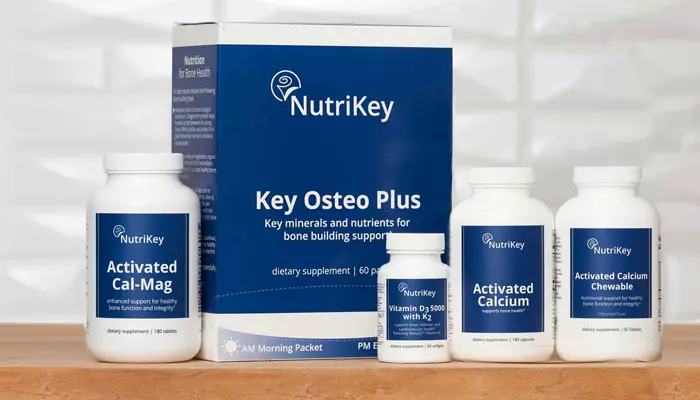
Britni: And you know, when a client comes into my office with a diagnosis of osteopenia or osteoporosis, I know it can be a very scary thing. So we want to give it our all to prevent or slow the progression of bone loss. You know, my go-to supplement recommendation is our Nutrikey Key Osteo Plus, because it covers our bone vitamin and mineral needs. It includes calcium, magnesium, strontium citrate, and all of the vitamins you would find in a multivitamin. So you don't need to take a separate multi.
Melanie: It's everything. It's your magnesium, it's your B vitamins, it's your multivitamin, it's your calcium, it's all the things. And if you start adding it all up together, it's a really good deal. But on top of it, it's the limousine of all the supplements for bone health and protection. So even though I have normal bone density now, I continue to take it as a preventative measure.
Britni: So it comes in individual AM and PM packets. So take the morning one with your breakfast, take the PM packet with your dinner.
Melanie: And is it multiple pills? Yes. But here's the thing. You can't just take one pill because when you activate and when you methylate and when you do all the things to vitamins and minerals that you need to absorb it properly, they're larger molecules. And so they're going to take up more space. And so do you need more? Yes, you do.
Britni: Yeah. Unfortunately, one or two capsules, tablets, just isn't going to cut it.
Melanie: It's not going to cut it, you're not going to absorb, and you're going to just feel really great. So many of the nutritionists have had multiple people that do the protocol. They do all the things and they've gone from osteopenia to normal bone, osteoporosis to osteopenia. It's the most gratifying as a practitioner that I think we see is someone who gains bone.
I've had two people in the past week who have reached out to me and they're so excited because they have gained bone and they were in their seventies and told you can't gain bone without medication. It's just not true. We see it weekly. And so don't be discouraged. If you don't know what your bones are doing, be proactive. Ignorance has never helped anyone. So when you don't know what's going on, you can't do anything about it. So these measures you can start if you're in your thirties, if you're in your forties, in your fifties, protect your bone.
Key Collagen is supportive for bone remodeling
And I would also recommend another product called Key Collagen. And Key Collagen, all you need is a scoop a day. You can put it in water or coffee or a smoothie. I love it because it has the collagen peptide Fortibone, which has been studied to improve bone remodeling.
Omega-3 fish oil supports bone remodeling & inflammation reduction
And also omega-3 fish oil supplement to reduce inflammation and support bone remodeling. We just need omega-3s in our diet.
Lactoferrin suppresses bone breakdown
I am big fan of lactoferrin for people who have already have compromised bone. Lactoferrin acts like a bone drug. It suppresses bone breakdown, it encourages bone buildup. There are no side effects. 250 milligrams is what I recommend.
Vitamin E (tocotrienols) are supportive for bone remodeling
And finally, there's another product that I really love. It's a form of vitamin E called tocotrienols. We have a product called Annatto Pro, and I have them take that away from their other vitamin E. They kind of conflict. And that one is great for bone remodeling in addition to cardiovascular health and inflammation. So there's a whole kit and caboodle we can put together if you're compromised. So let one of us professionals help you walk you through so that you're living in a place of power and not fear.
Stimulate bone with strength & resistance training
Britni: And in addition to the diet and the supplements, those play a key role. But it is also so important for women to stimulate bone with strength and resistance training for everything, not just bone health.
Melanie: For longevity.
Britni: Yes. So that doesn't mean you go to the gym and you start lifting the heaviest weights. That's an accident waiting to happen. It can be starting with two to three pound weights or even body weights to start with, a water bottle. Start where you feel comfortable and you can always build up from there.
Melanie: Another thing that you can do is while you're cooking, when you're brushing your teeth, you can do heel drops. You go up on your toe and down on your heels. The more barefoot you are, the better. And it's jarring and it's uncomfortable, but it tells your body build bone.
They did a study on women that stood on vibration plates, basically because they were assembly line workers and their platform vibrated. And so they had the bones of 20 year olds.
Britni: Wow.
Melanie: Because of that impact. So a little bit of impact. Don't be afraid if you've got the knees for it and you've got the back for it to do a little jumping. You know, we used to jump rope. We used to jump everywhere. Don't do this. But little kids, if we would jump off the second step, right? Or third step.
So if you're somebody that can throw some jumping in there. Jumping is a big deal. We've got to keep moving. But the key if your bones are compromised is not to injure and not to fall. So balance is key. So all of these activities also build balance.
Britni: And remember, your muscles need proper fuel to gain strength. So one habit we see affecting women is years of undereating, low calorie intake, very low-fat diets in the past, and inadequate animal protein, all reduce the nutrients needed to build healthy bone and muscles.
Bone health isn't just about adding in a calcium supplement. It's about consistently eating enough nutrients every day and working your bones and your muscles to support growth. So ideally your plate is full of colorful vegetables. You're having at least four ounces of quality animal protein with each meal.
Add in those healthy fats like nuts, seeds, avocados, olives, grass-fed butter, coconut oil. Those are going to provide the proper nourishment for our body and allow us to build bone and muscle.
Melanie: Yeah, we need that healthy fat. Let's say you're just like, I'm tired of thinking of this. Well go to our website and look up one of our protein smoothies. We've got so many. Every morning I make a smoothie just because it's an easy hack is I put in three or four frozen broccoli florets because I can get my vegetable in that way.
Sometimes I don't feel like plowing through a salad. I can get my protein, you can get your collagen in, I put some blueberries in there, but it's an easy way for me to start my day with colorful fruits and vegetables and protein.
Busting myths about bone loss in women
So to wrap up our conversation today, let's bust a few myths about bone loss in women. The first myth is that only older women need to think about osteoporosis. It's not true. The reality is that bone health begins in childhood and it continues throughout adulthood. It's never too early to start prioritizing your bone health. And that goes for men as well as women. Another myth is:
Britni: If you drink milk, you're protected. That is false.
Melanie: We are one of the highest dairy consuming countries and we have one of the highest osteoporosis rates.
Britni: I still remember that message as a kid. Drink your milk. You need that for strong bones. But the reality is bone health depends largely on protein, vitamin D, magnesium, vitamin K, exercise, your hormones, and yes, calcium, but in the mix of all of that.
Melanie: You know, another myth I hear is that thin women should avoid lifting weights. I have so many opinions. This could be a whole radio show. I remember when I had a ruptured disc and I was told not to do anything with my back. Well, guess what? The worst osteoporosis I had was in my spine because I never used my back muscles.
Well, you may be concerned that if you're thin and fragile, weight bearing will increase your risk of injury, which is quite the opposite, which is a valid concern. Do you need to do it with a trainer and somebody who understands your body mechanics? Absolutely. Do you need to start out the gate deadlifting 100 pounds?
No, not what we're saying. But even so, strength training is one of the best tools for preserving both muscle and bone. It's great for mental health. There's so many benefits. But no matter what stage that you're at, lifting heavy things is a good idea.
That being said, it's important to work with a physical therapist if you are at risk for bone fracture and just starting out. You may need to start very small. Always ask a trainer, do they work with people your age? Don't just say, do you understand osteoporosis? Say, what do you know about osteoporosis?
Don't let someone just throw weights on you and assume they know what they're doing. You need someone that understand how to progressively load your body over time. And if you're somebody who, gosh, you don't even think you have osteoporosis, but you want to prevent it, you need to lift weights also with someone who knows body mechanics and weights and isn't gung-ho and going to injure you. But don't sit and relax when it becomes easy. That's when you challenge your bones and your body. Start small and then work your way up.
Britni: And I think this is one of the biggest myths on this topic that osteoporosis is inevitable if you are a woman over a certain age. I have clients in their eighties, seventies. They do not have osteoporosis. So it is possible. The reality is aging and becoming postmenopausal, yes, they increase the risk, but many lifestyle choices have a meaningful impact on bone health and fracture risk.
And this topic comes up of women in many ages. You know, we talked about digestive issues earlier. That is going to relate back to bone health because again, if you're not absorbing your nutrients, that will impact your bones. So it is a topic that usually comes up regardless of why a client may originally come in.
Melanie: We see a lot of those people, Britni but the joy is we see a lot of success, both with prevention and also with recovery.
Wrap up
So to wrap this up, bone loss starts much earlier than most women realize or want to think about, to be honest. But peak bone mass is reached around the age of 30, then bone slowly declines afterwards. And menopause accelerates that process. Remember that the habits we practice today are an investment in stronger bones later in life. Every bite you take is harming or healing your bones. Bone health truly is a lifelong investment. Take care of your frame and it'll take care of you.
Britni: If today's conversation helped you, please share this episode with someone in your life that could benefit from listening. And if you would like personalized guidance on bone supportive meal planning or navigating supplement options, schedule an appointment with myself, Melanie, or any one of our dietitians or nutritionists at Nutritional Weight & Wellness. You can give us a call at 651-699-3438 or visit our website at weightandwellness.com to learn more.
Melanie: Our goal at Nutritional Weight & Wellness is to help each and every person experience better health through eating real food. Thank you for listening and we will talk to you next time.
Share this Podcast
Upcoming Podcast Episodes:
July 27: Recurring UTIs in Women: What a Dietitian Can Help You Learn
August 3: Talking Kids Nutrition with Captain & Cat